Sunday, December 8, 2013

Why Do People Like Harry Potter?

"I went off and read the books after the audition and I read the first four books in one sitting – you know – didn’t wash, didn’t eat, drove around with them on the steering wheel like a lunatic. I suddenly understood why my friends, who I’d thought were slightly backward, had been so addicted to these children’s books." - Jason Isaacs on the Harry Potter series

So why do people like Harry Potter? I have a few theories.

I know some of you are thinking this. Don't lie.

First, the world that Rowling creates is rich and expanisive – yet not overwhelming like Lord of the Rings or Game of Thrones. Let’s be honest here, your first time reading The Fellowship of the Ring is pretty difficult and don’t get me started on the first Game of Thrones novel (I still haven’t finished it). The worlds created by Tolkien and Martin are so detailed and masterfully created that it’s often hard to follow the plot and dialogue when the characters are making archaic references to things that happened hundreds of years ago or referring to elaborate family trees or histories. The Harry Potter world is fantastically immersive while still being simple enough to follow.

I should point out that this isn’t because Rowling doesn’t have her own person Silmarillion-esque catalogue of obscure HP related facts and family trees – she gives the reader enough detail without making them cringe.

"I checked this out weeks ago for a bit of light reading" aka hardcore Tolkien fans with the Silmarillion.


Second, the attention to detail and the little tidbits you didn’t realize at first meaning a whole lot more than you thought they did. For example, Argus Filch, the grouchy caretaker/janitor at Hogwarts always knows when students are wreaking havoc; he’s notorious for giving out detentions… he’s always watching. Just like Argus from Greek mythology – the 100 eyed giant that was tasked to guard precious items by Hera. When you notice one detail like that – so many more come forward. Remus Lupin – in Roman mythology Remus and his brother Romulus were raised by a wolf and found Rome and Lupin obviously comes from the Latin word for wolf “lupa.” To add to the symbolism, Sirius Black and Peter Pettigrew. Who sold out the Potters to Voldemort? Obviously Peter, whose animagus (or animal form they can turn into at will) – definitely not Sirius who transforms into a dog, a paragon of friendship and loyalty.

I could continue with that train of thought but I’ll refrain for your sake and mine. But if you’re interested in more allusions or symbolism in Harry Potter I wrote my senior English paper on it in high school and I still have it…

This tortoise understands me.

That conveniently enough brings me to my third point: nerdiness and community. The Harry Potter books and movies created a new community of avid readers from all walks of life. The books were great for children to grow up alongside Harry, but they were also interesting and compelling enough for adults too. Sure at the time there were huge cult followings for Buffy and Star Trek and Lord of the Rings, but Harry Potter reached a larger audience by including children and by widening the niche market for coming of age fantasy tales.

Author John Green’s vlog to his brother Hank explains as much, if you start at the 41 second mark and watch until 1:43 or so that's the segment that is really relevant to my post.


So that’s why I think Harry Potter is so popular – it’s easy to get into but it’s not boring, there is so much detail that to this day I’m still realizing things I didn’t notice the first dozen times I’ve read the book, and the community of Harry Potter lovers is a great place to not only discuss all of the aforementioned topics, but it’s also so wonderful to be in a theater/room, full of people all super excited for the same event.

Puzzled over the Possible Moral Presented in Rumplestiltskin

         I think most of us have heard of the story of Rumplestiltskin before. It is a classic and well known fairy tail which. However it has captured my interest for a few reasons. First, it is one of the better known fair tales that never (as far as I know) received a Disney adaptation. Unlike the other childhood stories that we have heard in the past (Cinderella and Snow White to name a few) this one was never presented to us as a sanitized (and de-awesomed) anamated feature curtisee of Disney. Yet, we have all probably at least heard the name Rumpldtiltaskin before, if we had not heard some version of the story itself. What give it this staying power? Probably the name itself helps, as it is incredibly distictive, and the mere mention of the name to a person who has not heard the story would probably merit a re-telling.

Although it did get a horror film adaptation. So.... that apparently happened.

However, what I find most remarkable about the story is not its staying power despite lacking a Disney adaptation. Instead it is that we have continued to hear it despit the fact that is has no clear moral. I have been telling several Grimm tales over the last serval days and at the end of several stories people have asked me " so what is the moral exactly?" Which caused me to automatically ask.... What the heck is the moral of Rumplestiltskin?!?

What is the lesson? It can't be "always keep your promises," because the woman clearly got out of having to give up her first born child by crying until Rumplstiltskin relented. Furthermore we, as the audience, clearly don't want the mother to be parted from her child, so keeping promises can't be it.

The lesson that Rumplestiltskin learned.
http://www.quickmeme.com/img/01/01a76400ed7c979aa543084630dd612e3c195fbd547202707c67829ae5940ef5.jpg

The moral can't be "don't boast unless you can make good on your word," because the father was the person guilty of that and it was not he that was punished for it, it was his daughter. The father also disappears half way through the story and is not heard from again (maybe his daughter was rightfully ticked off and did not want him in her life). Apart from being worried about his daughter (presumably) the father does not suffer at all. So "don't boast" can't be it.

On a side note, after the lady appears to have turned straw into gold the first time why does the king keep threatening to kill her? She has seemingly already done this feat once. Why risk killing the person who could potentially provide you with infinite wealth? 

It can't be "don't be greedy," because only the king is guilty of that and he gets everything he wants. Not once, not twice, but three times is straw turned into gold for him, he marries a woman whom he believes is capable of turning straw into gold, and he gets to keep his firstborn child. This guy gets everything he wants!

So the moral appears to be: you should seek to always appease your ever growing greed... Well that's a new one.
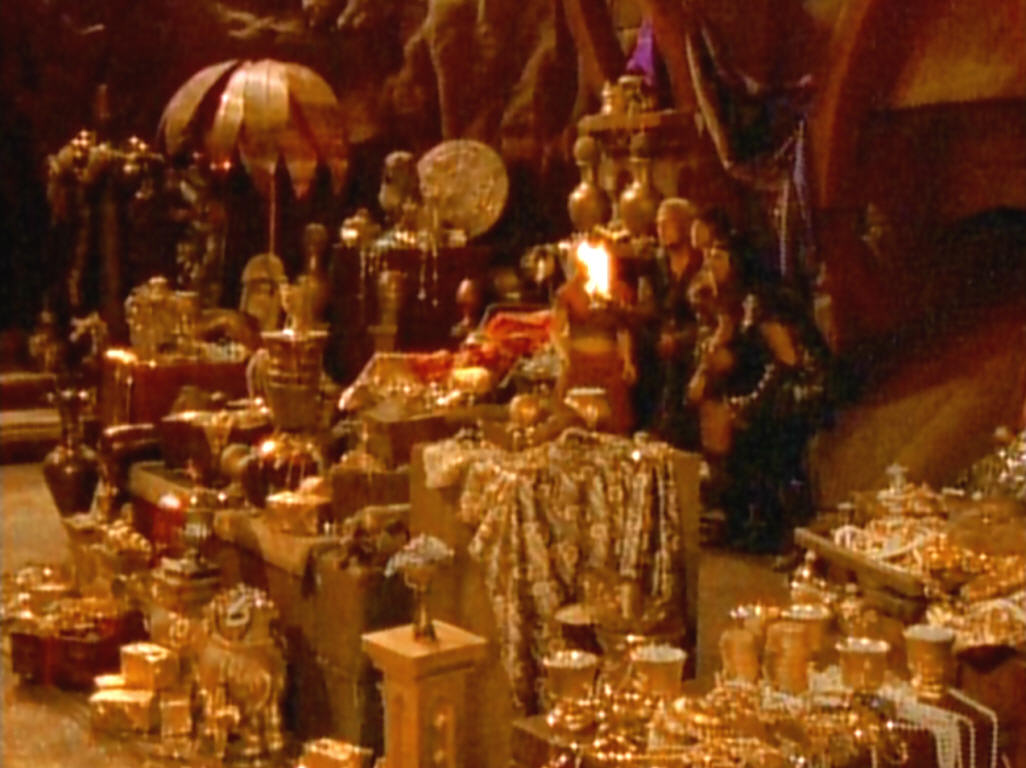
http://images2.wikia.nocookie.net/__cb20110123012542/hercxena/images/e/eb/Sumerian_Treasure.jpg

The moral can't be "don't make promises you aren't prepared to keep," because if the girl had not promised to give Rumplstiltskin her child then she presumably would have died (although he only said he would marry her is she succeeded, but I feel it's a pretty safe assumption since he threated that the two times previously). As the audience don't want an innocent prison to die because of the stupid boasts of her father, so the previously mentioned lesson does not really aply. But what is left?
So remember, keep your promises children, unless there is a mysterious, gold-spinning elf involved. In which case all promises, agreements, and contracts are null and void.

Does this story even have a lesson? Does it have a moral that the audience is supposed to take away? Or is this story just .... well, a story. A series of events that capture the audience's attention and provide entertainment but achieve nothing else?

Shut up children and you shall hear
A tale I'm currently pulling out of my... ear.

 The closet thing that I can pull from it is that "good will always prevail in the end, and the perpetrators of evil will be punished for there wickedness."

...By ripping themselves in half!!!

This is not a bad lesson, it just feels..... broad. Compared to some more applicable morals in other stories (Snow White= your envy and jealousy will make you do bad things and may make you into a bad person) this feels more like an outlook that one it trying to impart as opposed to a directly applicable life lesson.

What do you guys think? It there a moral? Is this just a really catchy story that has survived the test of time? Is it a tale showing that good will prevail over wickedness? What is it? WHAT IS IT?!?

Good enough for me!
 
4 of 5


Friday, December 6, 2013

Facts you didn’t know about Lord of the Rings and J. R. R. Tolkien:

1) Tolkien fought in WWII but only enlisted because his family pressured him. In fact, he applied for a program that allowed him to complete his degree. He only made it out of the war alive because he contracted Trench Fever, which is a disease that is carried by lice. It isn’t serious, just pretty unpleasant and was pretty common during WWI. He was deemed “unfit for general services.”

2) Tolkien was friend with C. S. Lewis (he wrote Chronicles of Narnia if anyone has been under a rock for the last few decades.

3) The Special Editions of all three of the movies are 158 minutes longer than the Theatrical releases.

4) WHAT EVERYONE COMPLAINS ABOUT. Tolkien did not have the eagles fly the crew to Mount Doom because he did not want to give the impression that they were “Middle-Earth taxis.” They are their own race. Also, he found them one-dimensional and did not like them.

5) The first Portuguese version of The Hobbit was changed into O Gnomo (the Gnome).

6) Christopher Lee (Saruman) is the only actor in the Lord of the Rings films to have met Tolkien. In fact, Tolkein’s dying wish was to have Lee play Gandalf if there was ever a Lord of the Rings film. Adding to his badassory, Lee formed a metal band, holds the Guinness Book world record for being the tallest leading actor in Hollywood (6 foot 5), and he was related to Emperor Charlemagne.

7) When Tolkein’s son Michael went into the army, he had to fill in paper work. Under his father’s profession, he wrote ‘Wizard.’

8) In the 1960s the Beatles approached Stanley Kubrick with an idea: they wanted to make a live action version of the Lord of the Rings.  It would have featured John Lennon as Gollum, Ringo Starr as Sam, George Harrison as Gandalf, and Paul McCartney as Frodo. But Kubrick wasn't interested.

9) Sean Connery turned down the role of Gandalf because he didn't understand the story.

10) Tolkien would often start lectures off in an energetic way. Sometimes he would put on full chain mail armor or come in reciting the first lines from Beowulf at the top of his lungs.

11) Tolkien did not see Frodo as the hero of The Lord of the Rings he said that the true hero was Sam. From that perspective, it would change the opinion of any first time reader.

4 of 5

Harry Potter is a cool guy

So my mom was the one who first told me about Harry Potter.  I think I was in third grade or so when it happened.  My mom convinced me to let her read me the first chapter.  Just the first chapter and if I did not like it then she would stop reading it to me.  Well when she was done reading it I told her that it was alright but I did not want to keep reading it.  Later that day though I saw the book on a table in our house, picked it up and kept reading it.  It was out of pure curiosity.  But a few chapters later I was hooked on it.  And the same goes with the subsequent books.  I liked all of them, and there was actually not one part of any book that I thought was bad and didn't need to be in there.

I'm not someone who is obsessed with the series but I haven't really forgotten anything from any of the books, the stuff has just stuck with me and I'm not mad about it at all.  One reason I found them so appealing when I was younger was because it just made you were at that gullible age and it made you believe that there was this other side to  the world where there was real magic and wizards and witches.  It was a place to get away.  I mean yeah all of that stuff is not real but for young kids who do not know any better then it was awesome for them.

I liked all of the movies as well. Some of them definitely left out important stuff that was in the books but I got over that eventually.  I never watched the movie until I finished the book that movie was from too.  And every time I see one of the movies or read a part of one of the books it just reminds me of the time where you really believed in it.  It was something to look forward to doing when you got home from school.  Some times I would get in trouble because I was up so let reading the books but they are that good and they can really hook you into them.  There wasn't one bad character in them.  The key to reading them I think is to start off with an open mind because if your first thought when you're reading it is that it is stupid then you will never be able to get that thought out.  If you can give the first book a chance then you will definitely want to read the second and so on.

Freaking Patriarchy, Man

When discussing Harry Potter and Lord of the Rings in class the other day, the opportunity was taken to discuss why both Dumbledore and Gandalf were both men, which ultimately lead to the discussion ending on the cry of “freaking patriarchy, man.”

For the sake of playing Devil’s Advocate (so put down your pitchforks and stop looking for a photo of me wearing a fedora) I would like to take just a quick moment to suggest that, with regard to the character situation itself, it may be entirely possible that the characters were simply written as male, because why not? I say this out of the same curiosity that asks “Why wasn’t Dumbledore a woman?” but came to the opposite conclusion - that it really doesn’t matter one way or another, because nothing in the story particularly deals with Dumbledore’s gender identity. (His sexuality was such a non-issue, partly because he was an old man and this was a children’s book, that it wasn’t until Rowling made a statement after the fact that we knew he was gay.)

There’s very real concerns spawned by “patriarchy,” including Joanne Rowling being told to have the front of her book list her name as ‘J.K. Rowling” out of a concern that boys wouldn’t read her book if they thought she was a woman, but I really and truly fear that we’re approaching a reductio ad absurdum kind of moment by questioning why these two characters were both male. Rowling was clearly inspired by Tolkien, who wrote a male mentor-wizard because it was probably something he felt like he was capable of writing.

If I’m horrifically wrong or if you just have a very strong opinion, let me know in the comments. I kinda just wanted to throw a possibility out there.

---

4 of 5

Harry Potter, my life in a nutshell

Harry Potter was introduced to me by simply hearing it every night my mom would read it to me. I was just getting the concept of reading at that time. Because I couldn't read, the entire time I sat there and listened I created my own world in my head. Once I got to reading, the world only got more and more vivid and an escape. The very same can be said about Lord of the Rings. Out of the two, Lord of the Rings is usually my favorite, but it depends on the day because I really love Harry Potter too.
However, the real emphasis I want to make on this post is what both of these books/movies did for me. Every kid has something they like barbies, cars, guns, sports, you name it. Well my hobbies were drawing, writing, movies and books. The thing that all of those have in common is that they all had to deal with different types of people, places, and creatures. I loved the idea of living in a world far from ours.

The moment I read the books, even more watching the movies, I became obsessed. I was taken away, quite literally. The pure magic, no pun intended, that was created on the pages and screen were beyond my comprehension at the time. Ever since I ever heard the words Harry Potter or Frodo Baggins, I’ve always wanted to make my own story. It’s definitely one of my life time goals that is definitely in the making.  

Thursday, December 5, 2013

Harry Potter

Personally, I am not a big fan of Harry Potter. I know 'Gasp' right? I just never could get into any of the books. I think it had something to do with the big hype around how good they were, and I am not much of a reader to begin with too. Every one was saying they were the best book sat the time, but I got to like the third chapter and was just like "This is boring I am going to go play video games."
Now having said all that, I can totally understand why they became such a big success, and why everyone loves the Wizarding World of Harry Potter so much. For one thing, I think the books did so well due to the hype of the books, and not just the positive hype. When the books first came out there was this huge hype about not allowing the books in school because some parents got upset with the whole"wizards" thing, think the book is like satanic and goes against the christian religion. Which as we have learned in class, Christianity has a big problem with magic and witches and wizards dating back to like 400 a.d in Europe (even further probably but 400 is the date on our Kors and Peters Book) Now you may be thinking, "well if the book was possibly being banned then how did it get so popular?" Well that's just it, it became popular because it became so well known for being a controversial book. When you think about it, being infamous gets just as much attention as being famous, Hitler, Stalin, Italian dictator named Montecelli or something, Osama Bin Laden for example. All these names are well known, but not in a positive way at all. The same thing goes for books, Harry Potter was flagged as controversial, and so everyone wanted to see why it was controversial so they read it. Even if you didn't read it you still knew about it and knew like 30 people who had read it and so it became famous/infamous. And by the time all the controversy around the book being not suitable for schools died down, it was already one of the most well known books of the time. If you hadn't read it you would have been a social pariah since every one else would have been talking about it. I know that why I tried to read it, every one else talked about it all the time and because I hadn't I had very little input on conversations revolving around the book. As they say in the entertainment world, "There is no such thing as bad press." What they mean is even if people are saying bad things about a product, its still being talked about and people learn more about it and recognize it more and more. Harry Potter wasn't even the first book to become popular partly due to controversy. "The Catcher in the Rye" became infamous when the guy who shot John Lennon said the book made him do it. Nowadays in school, everyone reads The Catcher in the Rye, South Park even made an episode revolving around that book.
That's just my thoughts on why Harry Potter became so famous, we didn't talk actually talk about this reason in class so discuss your thoughts in the comments or hold them for the next class and maybe we will bring this topic up then.